Key facts: Commercial Water Damage
- The IICRC S500 standard covers commercial as well as residential water damage, with the same water categories and drying principles [1].
- Commercial roofs, fire sprinklers and rooftop HVAC units are common sources of water damage in business buildings.
- Mold can start on wet materials within 24 to 48 hours, which matters even more in buildings with many occupants [2].
- Some commercial losses also involve local permits for repairs; check with the City of Mansfield before rebuilding [3].
The basics
How commercial water damage differs
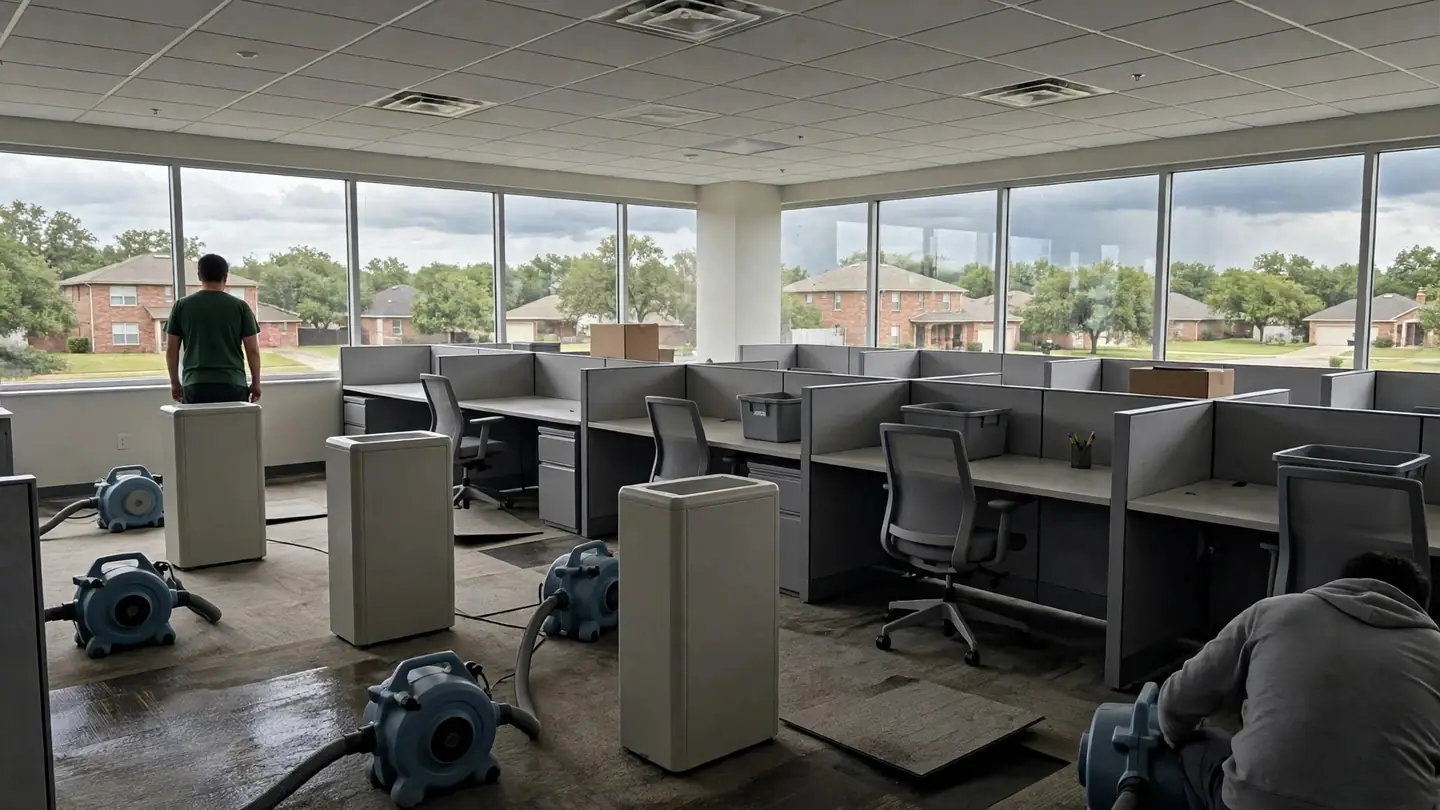
The physics of drying are the same in an office as in a house. What changes is scale, access and the number of people affected. A commercial building may have long runs of carpet tile, suspended ceilings hiding wet insulation, server rooms, inventory on pallets and tenants who all need answers at once.
Commercial restoration plans for those things. Work may be split into phases so part of the building stays open. Equipment may run overnight and be moved before staff arrive. A single point of contact keeps owners, managers, tenants and insurers informed. The goal is to dry the building properly while keeping the business running as much as possible.
Sources
Common commercial water sources
Fire sprinkler discharge
A sprinkler head knocked or frozen can release a large volume of water in minutes across several rooms.
Roof leaks
Flat and low-slope roofs on Mansfield strip centers and offices collect water at drains and seams, and leaks show up in ceiling tiles.
Rooftop HVAC units
Clogged condensate drains or damaged units on the roof send water through the roof deck into ceilings below.
Restroom fixtures
Flush valves and supply lines in busy restrooms fail more often, and the water can run unnoticed after hours.
Kitchen equipment
Restaurant dishwashers, ice machines and walk-in coolers have lines and drains that can leak behind equipment.
Storm water
Water entering at storefront doors and loading docks during heavy rain.
Main causes
Sprinklers, roofs and rooftop equipment
Fire sprinkler systems are designed to put out a lot of water fast, which is exactly why an accidental discharge is so damaging. A head broken by a forklift, a ladder or freezing can soak an entire suite before the system is shut down. The first step is always to get the system shut off by someone authorized, then to have it restored quickly so the building is protected again.
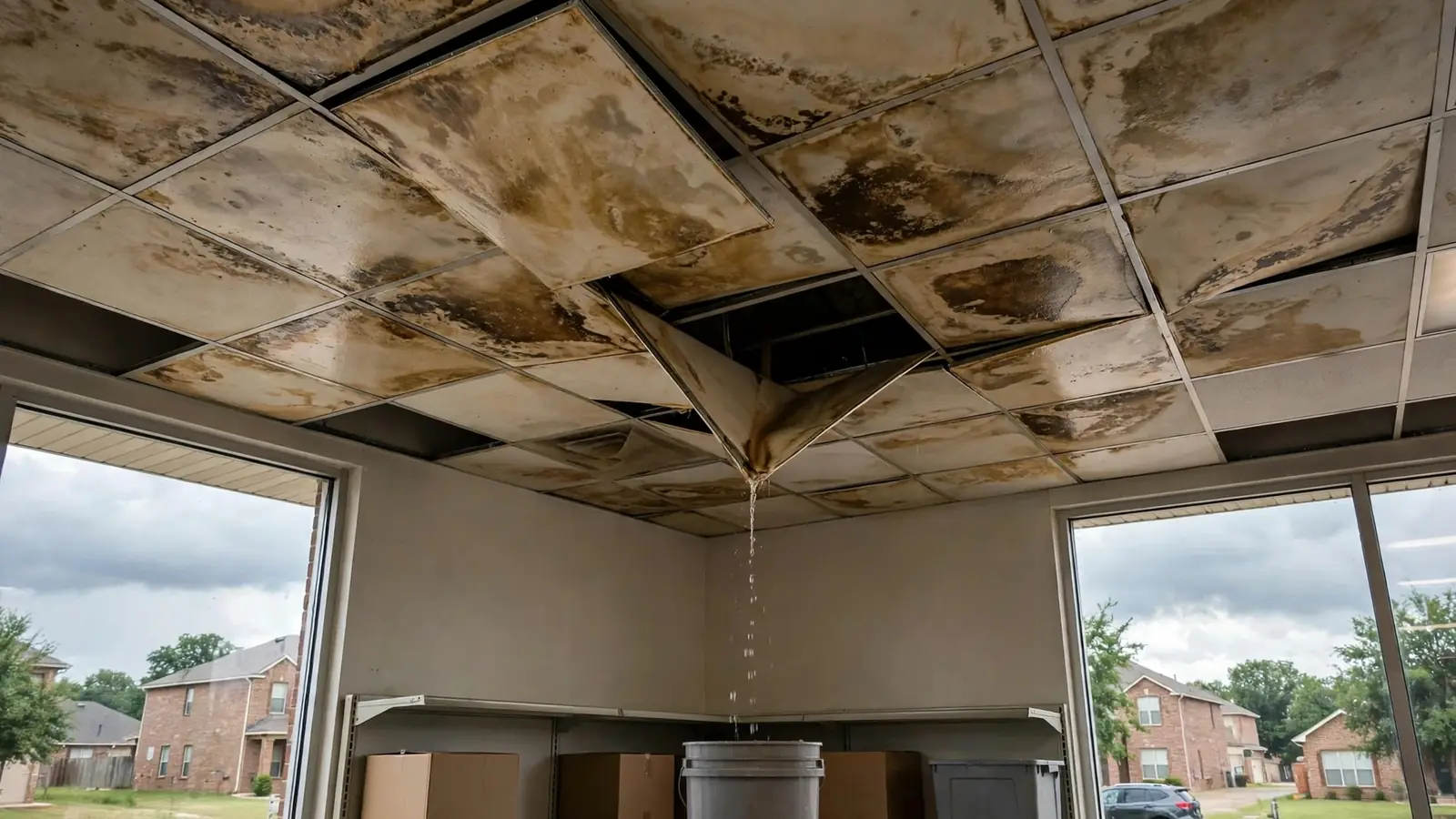
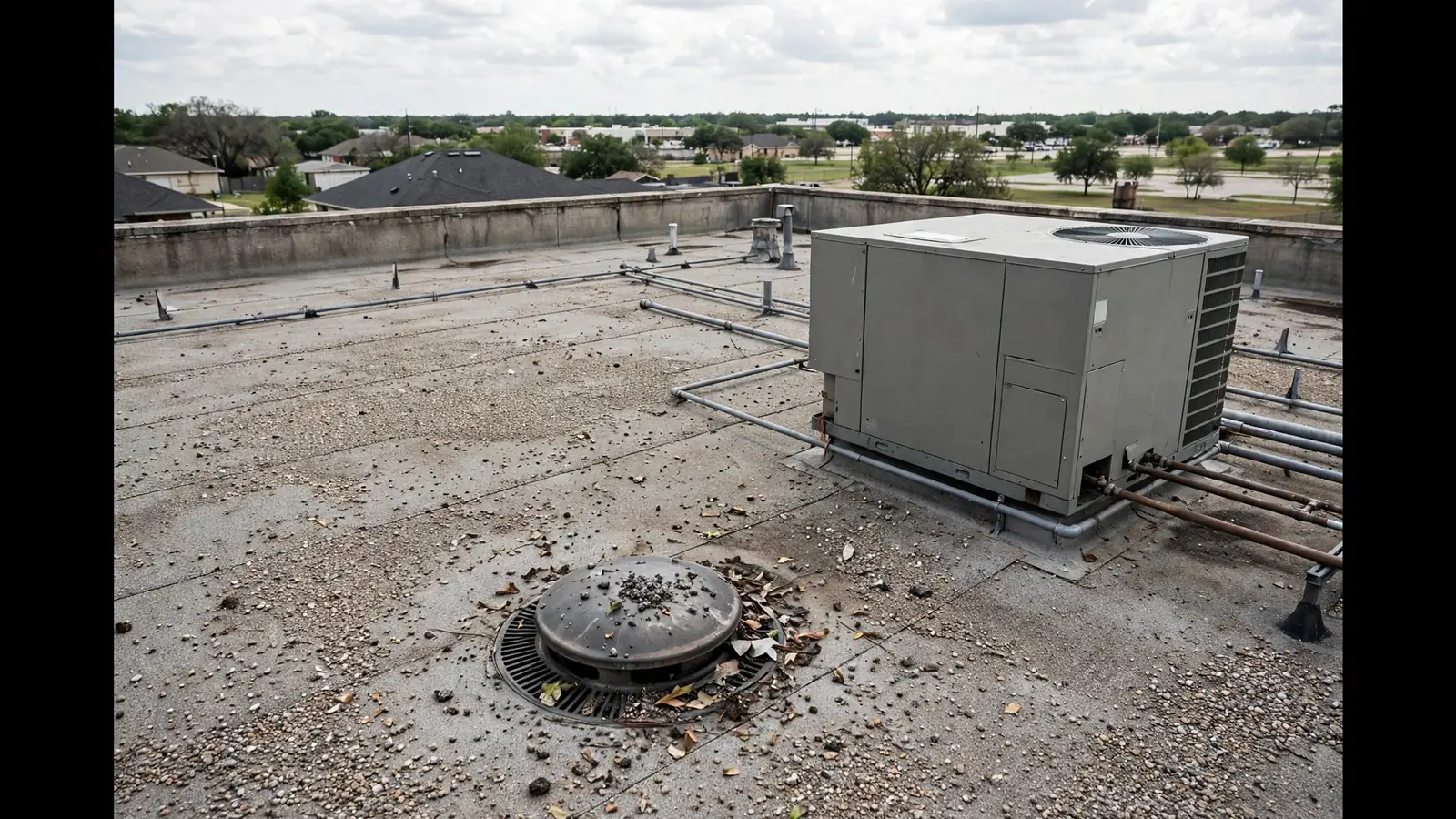
Low-slope roofs common on Mansfield retail and office buildings hold water at drains, scuppers and seams. Leaks often travel along the roof deck before dripping, so the stained ceiling tile may be some distance from the actual opening. Roof repair and interior drying need to be coordinated.
Rooftop HVAC units produce condensate all summer. A blocked drain line can push that water back through roof penetrations into ceilings below, and in a humid Texas summer the volume adds up quickly.
Assessment
How a commercial water loss is assessed
- 1
Site walk with the owner or manager
The contractor walks the building with someone who knows its layout, systems and occupants.
- 2
Source and safety
The water source is confirmed off, and electrical, slip and ceiling hazards are noted.
- 3
Moisture mapping
Meters and thermal imaging map wet areas, including above ceilings and inside walls.
- 4
Water category
The source sets the category: sprinkler water is often treated more cautiously than clean supply water because it has stood in the pipes [1].
- 5
Business impact
The contractor asks which areas must stay open, what hours work can happen and where equipment can safely run.
- 6
Written scope
A scope and drying plan are agreed between the business and the contractor.
Diagnosis
Commercial materials and how they dry
| Material | Usual approach | Notes |
|---|---|---|
| Carpet tile | Lift, dry slab, reinstall dry tiles | Glued tiles may need replacing |
| Broadloom carpet glued down | Often removed | Adhesive traps water on the slab |
| Suspended ceiling tiles | Wet tiles replaced | Insulation above may need removal |
| Steel stud and drywall walls | Dried in place or flood cut | Steel studs do not absorb water |
| Millwork and casework | Toe kicks removed, bases dried | Particleboard often replaced if swollen |
| Polished or sealed concrete | Extracted and dried | Usually recovers well |
| Server and electrical rooms | Specialist assessment first | Power and data equipment must be checked before restart |
The job
How commercial restoration is carried out
Large commercial losses usually start with extraction across big floor areas using truck-mounted or high-capacity portable units. Wet ceiling tiles come down to relieve weight and let the space above dry. Inventory and furnishings are moved to a dry area on site or off site, with a written list.
Drying a commercial space can take more equipment than a house, and often uses large desiccant dehumidifiers or trailer-mounted units that feed dry air into the building through ducting. These units handle big volumes and work well in cooler conditions, such as when building systems are shut down.
Throughout the job, daily moisture readings and photos are logged. For tenants in a multi-tenant building, separate records for each suite make insurance claims and lease questions easier to settle.
Downtime
Keeping the business open during restoration
| Approach | How it works | Best for |
|---|---|---|
| Phased work | Dry and repair one section at a time while others stay open | Offices, larger retail, schools |
| After-hours work | Noisy work and equipment moves happen outside business hours | Restaurants, medical offices, shops |
| Containment | Plastic barriers and air filtration keep dust and noise away from open areas | Healthcare, food service |
| Temporary relocation | Staff or inventory moved to unaffected areas or another site | Severe losses |
| Equipment scheduling | Quieter equipment during the day, heavier set-up at night | Shared buildings and churches |
Mansfield specifics
Mansfield's commercial buildings
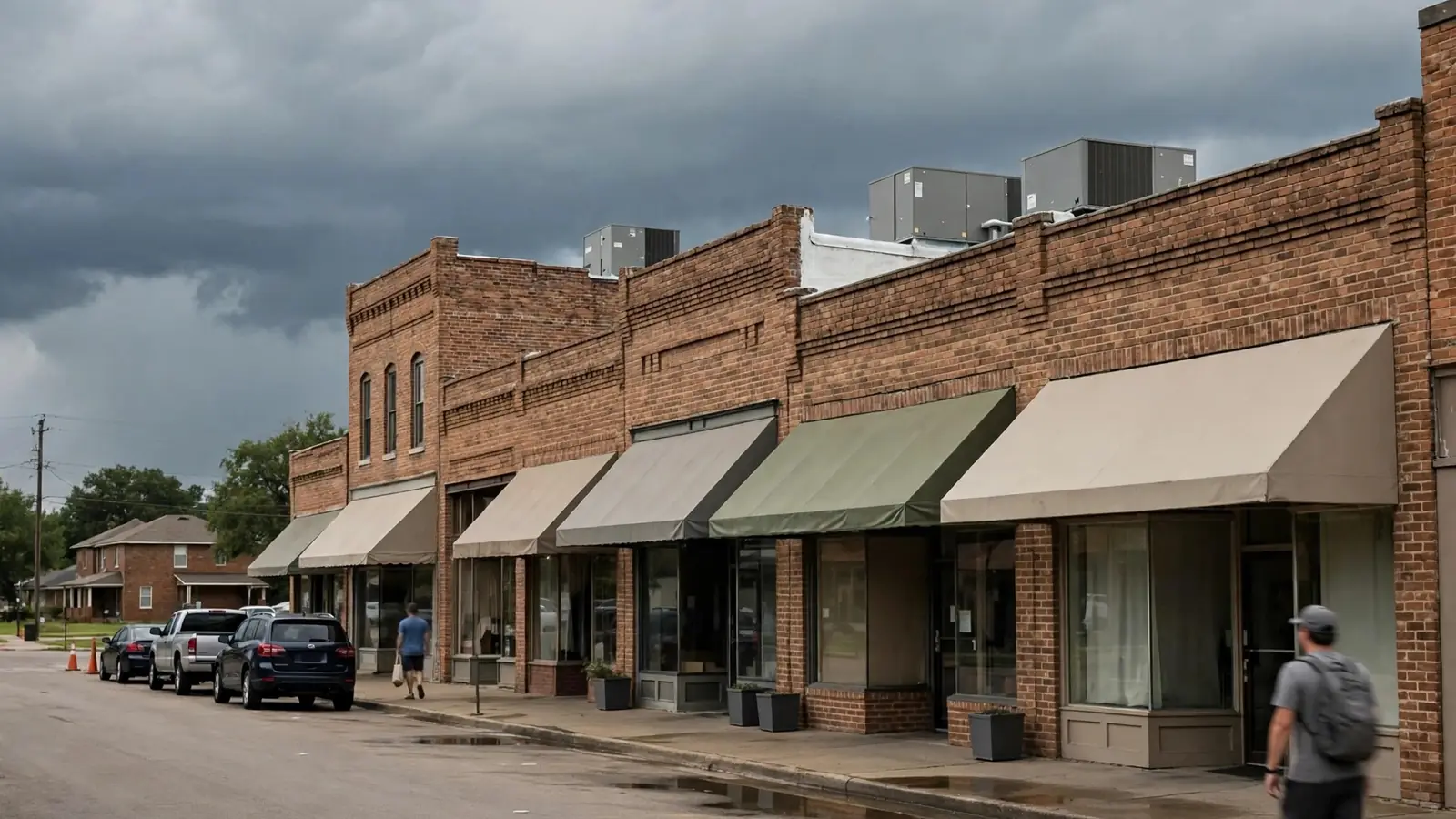
Mansfield's business buildings range widely. Historic Main Street has brick buildings from the 1890s with wood floors and plaster that dry differently from modern finishes [4]. Along the city's main corridors there are strip centers with low-slope roofs, medical and professional offices, restaurants and large retail. Industrial and warehouse space adds tilt-wall buildings with big concrete floors.
Each type has its own pattern. Historic buildings need care with original materials. Strip centers often share walls and roofs, so one tenant's leak can affect neighbors. Restaurants have food safety rules that shape what can be kept and how the kitchen is cleaned. Offices may have raised floors or server rooms that need specialist attention.
Churches and schools often have large open rooms with carpet over slab, kitchens and storage full of paper. They are also used on fixed schedules, which affects when noisy work can happen.
Restaurants
Restaurants and food service
Water in a restaurant raises food safety questions as well as building ones. Food, packaging and single-use items touched by contaminated water are generally discarded. Food-contact surfaces are cleaned and sanitized before service resumes, and any requirements from the local health authority must be met before reopening.
Kitchen floors with quarry tile and floor drains handle surface water well, but water can get under equipment and into walls behind cooking lines. Walk-in coolers can trap water in their insulation if the panels are damaged. A contractor familiar with commercial kitchens will look at those spots early.
Offices
Medical, dental and professional offices
Clinics and offices often hold records, specialized equipment and patients who cannot be exposed to dust or spores. Containment and air filtration matter more in these settings. Paper records that got wet may need specialist drying, and electronic equipment should be checked by the manufacturer or a qualified technician before it is powered up again.
Planning around appointment schedules keeps disruption down. Some practices work from an unaffected part of the suite while the wet area is dried.
Leases
Owners, tenants and leases
In a leased building, responsibility for different parts of a water loss can be split. The landlord may be responsible for the structure, roof and building systems, while the tenant handles its own improvements, furnishings and stock. The lease decides this, not the contractor.
For that reason it helps to agree early who is authorizing which work, and to keep records for each party. Separate photos and moisture logs for the landlord's and tenant's portions make the insurance side clearer for everyone.
Community buildings
Churches, schools and community buildings
Places of worship and schools tend to have large rooms with carpet glued over slab, folding tables and chairs, kitchens used for events and storage rooms packed with paper, costumes and supplies. A leak in a fellowship hall or classroom over a weekend can go unnoticed until the next service or school day.
These buildings also run on fixed calendars. A restoration plan that keeps the sanctuary or main classrooms usable while a side wing dries is often possible with containment and careful scheduling. Volunteers who want to help should leave cutting and removal to the crew, but they are often a great help moving chairs and boxes to a dry area under direction.
Warehouses
Warehouses and light industrial space
Tilt-wall warehouses have tall ceilings, big concrete floors and stock stored on pallets or racks. Water spreads across the slab quickly and wicks into the bottom layer of cardboard boxes on every pallet it reaches. Moving or lifting stock fast is the biggest single way to cut losses.
Concrete floors usually recover well once surface water is removed, but office areas built inside warehouses often have drywall and carpet that need the same attention as any office. Large desiccant units are common on these jobs because the air volume is so big.
Contents
Stock, records and equipment
Listing and photographing business contents before they are moved helps both your insurer and your own records.
| Item | Usual handling |
|---|---|
| Boxed inventory on the floor | Moved, inspected and set aside; wet packaging often means the item is listed for the claim |
| Paper records | Moved to a dry area; important wet files frozen or sent for specialist drying |
| Computers and electronics | Unplugged, moved and checked by a technician before use |
| Office furniture | Metal and laminate cleaned and dried; upholstered seating assessed |
| Display fixtures | Cleaned and dried; particleboard bases checked for swelling |
Before you call
Have this ready when you call
Clear answers help the contractor plan equipment and crew before arriving.
- Building type and sizeAn office suite, a whole building, a restaurant, a warehouse.
- Where the water came fromSprinkler, roof, plumbing, storm or unknown.
- Is it still running?Whether the source has been shut off.
- Which areas are affectedRough number of rooms or square footage, and whether ceilings are wet.
- Who can authorize workThe owner, manager or tenant who can approve the scope on site.
The visit
A commercial restoration visit
- 1
Call any hour
You call the line, explain the loss and arrange the visit with the contractor on the call.
- 2
Site meeting
The contractor meets the owner or manager on site to assess the building and its use.
- 3
Emergency control
Water extraction, ceiling tile removal and protection of contents start once you approve.
- 4
Drying plan
Equipment is placed and a schedule set around business hours.
- 5
Daily updates
Readings, photos and progress are shared with the people who need them.
- 6
Close-out
Final readings confirm the building is dry and ready for repairs.
Prevention
Preventing commercial water damage
Roof and HVAC maintenance prevents many commercial losses. Clearing roof drains and scuppers before storm season, checking flashing around rooftop units and flushing condensate lines before summer all reduce risk.
Sprinkler systems need regular inspection and testing by a qualified fire protection company, and protection from freezing in unheated areas. Staff should know where the sprinkler control valve and the main water shut-off are and who is authorized to use them.
Water sensors in server rooms, restrooms and kitchens can send an alert after hours. A short written plan listing shut-off locations, emergency contacts and who to call can save hours on the night of a leak.
- Clear roof drains before storm season
- Flush HVAC condensate lines each spring
- Schedule sprinkler inspections
- Write down shut-off locations
Reopening
Rebuilding and reopening
Once drying is complete, the building moves to repairs: new ceiling tiles, drywall, paint, flooring and any millwork that was removed. Some of that work may need a building permit from the City of Mansfield, especially where walls are altered or electrical and plumbing systems are touched [3]. Ask whoever is doing the rebuild to confirm what is needed.
Before reopening a space to the public, walk it with the contractor. Look for remaining stains, check that ceiling tiles sit flat, make sure floor transitions are not a trip hazard and confirm there is no musty smell. For restaurants and clinics, any health or licensing inspections should be cleared before customers or patients return.
Afterwards, keep the drying records, photos and invoices together with your building files. They are useful at renewal time, if a buyer or new tenant asks about the building's history, and if a related issue surfaces months later.
Finally, take a few minutes to review what happened. If the loss came from a roof drain, a sprinkler head or a failed restroom line, the same weak point probably exists elsewhere in the building. A quick check of similar fixtures and drains now can prevent the next call.
Communication
Communicating during a commercial water loss
Commercial jobs involve more people than a house: owners, managers, tenants, staff, sometimes customers and members of the public. Mixed messages cause problems, from staff entering contained areas to tenants unsure whether they can open. Agreeing at the start who speaks for the business and how updates will be shared makes the job smoother.
A short daily update is usually enough: which areas are drying, which are ready, what equipment is being moved and what is planned for tomorrow. Posting simple signs at containment doors and on equipment helps keep staff and visitors out of work areas and away from cords and hoses.
For insurers, a single file with photos, moisture logs, the scope and any change orders saves time later. Ask the contractor how they will share that record and how often.
Finishes
Tenant improvements and specialty finishes
Many Mansfield offices and shops have finishes added by the tenant: glass partitions, custom millwork, specialty flooring, signage and lighting. These often take longer to replace than the base building, so drying them in place where possible protects both the schedule and the look of the space. Photograph them in detail before any removal so they can be matched later.
Ask the contractor to note which items are building-owned and which belong to the tenant in the scope and the photos. That simple step makes it much easier for each party's insurer to handle its share.
Where a finish has to come out, keep a sample piece so the replacement can be matched in color, size and texture.
FAQ
Commercial water damage questions
Can my business stay open during drying?
Often, in part. Phased work, containment and after-hours scheduling can keep unaffected areas open. It depends on the extent and type of damage.
How long does commercial drying take?
Many commercial losses dry in three to five days, but large buildings, dense materials or contaminated water can take longer.
Who coordinates with the landlord or tenants?
The business authorizing the work and the contractor agree how updates are shared. Separate records for each party help.
What about our server room?
Power and data equipment that got wet should be assessed by a qualified technician before restart. Drying the room comes alongside that.
Is sprinkler water clean?
It has usually stood in the pipes for years and can be dirty or rusty. Restorers often treat it with more caution than fresh supply water.
Does business insurance cover water damage?
Coverage depends on the policy and cause. Some businesses also have business interruption coverage. Ask your agent or insurer.
Can we call after hours?
Yes. Calls are answered 24/7 and connect to an independent local contractor.
Does this site perform the work?
No. This is a referral line; the contractor you speak with is independent.